About this
research project
We study how groups change their mood and mindset over time—sometimes helping real work, sometimes avoiding it. This site brings together researchers and practitioners using Reversal Theory to observe those shifts.


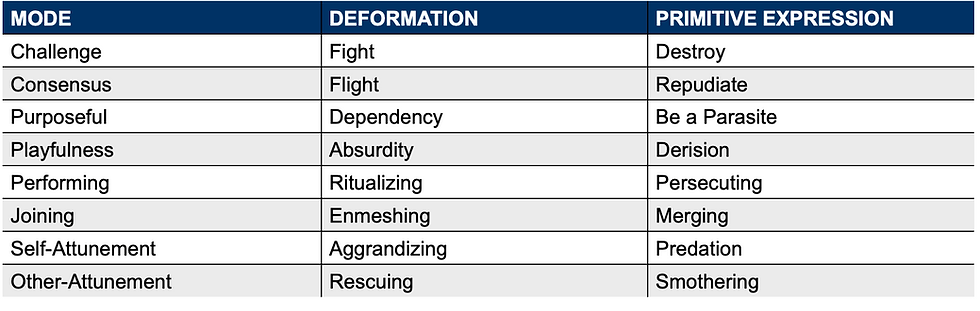
Reversal Theory posits that groups accomplish their work by moving among four main modalities, each with two poles: challenge / consensus, purposeful / playful, perform / join, and self-attunement / other-attunement. When groups become anxious about their work, they can regress. For example, a group operating in the challenge mode may slide into a stance of fighting, and a group in the performing mode may ritualize its conduct. Groups that are truly lost may become primitive; members who are “just fighting” may begin to attack and try to destroy one another’s viewpoints or personal standing in the group.
Type of research

1
Explicit coding
We use structured coding schemes to track how a group’s mood and stance change over time. These reports often combine time-stamped codes with brief comments about what was happening in the room, so others can see how the categories were applied.
3
Everyday experience
These are descriptive vignettes of everyday experiences we have as members of groups trying to accomplish work. They describe how we experience modes, reversals, and regressions, what we felt and what we did, if anything, in response.